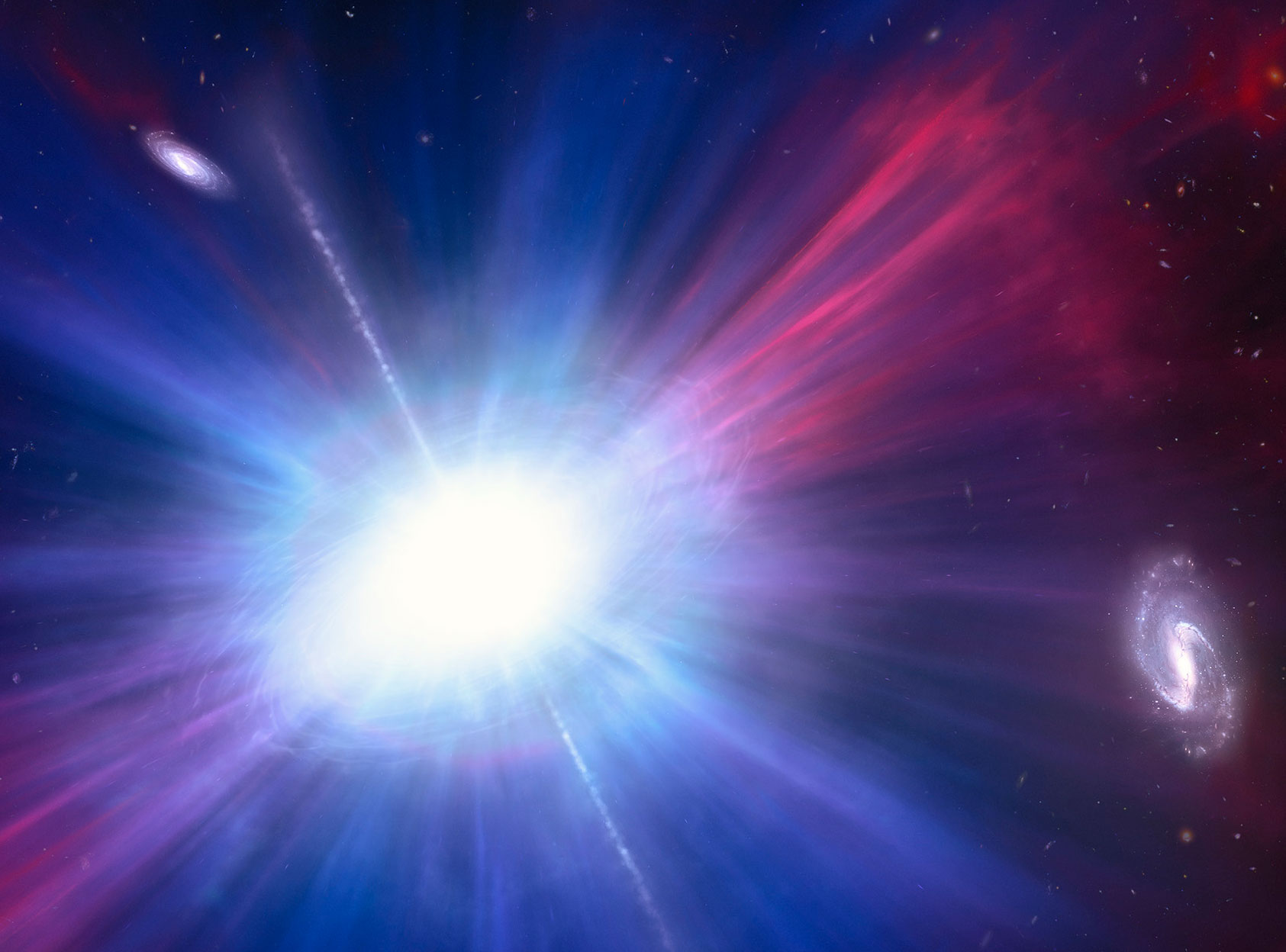
Artists' impression of a luminous fast blue optical transient (LFBOT). Adapted from an image by NASA, ESA, NSF’s NOIRLab, Mark Garlick, and Mahdi Zamani.
Two recent papers (linked below) by Dr Dan Perley and Dr Conor Omand detail the involvement of the Liverpool Telescope (LT) in helping astronomers to understand a class of rare and mysterious cosmic explosion, the latest of which happened relatively nearby.
Luminous Fast Blue Optical Transients (LFBOTs) are a growing class of enigmatic energetic transients, brilliant cosmic explosions that brighten quickly and shine mainly in the blue part of the spectrum. Unlike typical supernovae, these events have a rise time of no more than a few days, an absolute magnitude of about -20, and a hot (>15,000K) featureless spectrum lasting for weeks after peak brightness. They also emit brightly in X-ray, radio and millimetre wavelengths.
The high luminosity implies a substantial release of energy, but the fast rise time and absence of spectral features imply little ejected matter. The rapid variability of the source brightness indicate an unstable and energetic compact object as the central engine behind the explosion.
These objects do not fit into the known categories of stellar explosions, and there is currently no consensus on the nature of these objects. What's more, LFBOTS are rare so there are only a few examples to study. Only a few are detected every few years, in wide field surveys like the Zwicky Transient facility (ZTF) and the Asteroid Terrestrial-impact Last Alert System (ATLAS). Once detected, the call immediately goes out to other facilities for much more detailed high-cadence followup observations in multiple wavelengths, so that the evolution of the explosion can be characterised as completely as possible.
Such an alert went out on 25th September 2024, when ZTF detected the most optically luminous LFBOT to date. Later analysis would show this was also the fourth closest LFBOT known, at just over a billion light years away. It was assigned the name "AT 2024wpp" (nicknamed "Whippet"), and prioritised for immediate followup.
Thanks to the scheduling flexibility afforded by its rapid-response capabilities, the LT was one of the first of a cadre of facilities to obtain these crucial early-time followup observations. Three of its battery of seven sensors were pressed into service immediately to obtain high-cadence data in all filters — the IO:O optical camera, LIRIC infrared camera and SPRAT spectrograph.
Other facilities adding to the data haul were: the Rainbow Camera on the Palomar 60-inch telescope; the Panoramic Survey Telescope and Rapid Response System (Pan-STARRS); the Wide-Field Infrared Survey Telescope (WINTER); the Goodman High-Throughput Spectrograph (GHTS) on the Southern Astrophysical Research Telescope (SOAR); the ESO Faint Object Spectrograph and Camera v2 (EFOSC2) on the New Technology Telescope (NTT); and the Focal Reducer/Low Dispersion Spectrograph 2 (FORS2) on the Very Large Telescope (VLT).
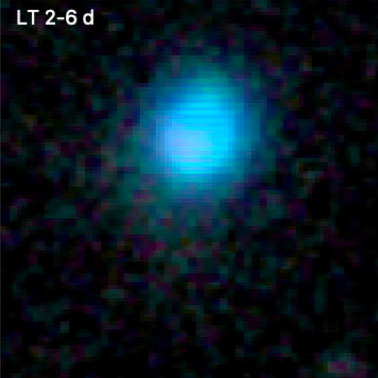
LT IO:O image of AT 2024wpp, a stack of multiwavelength data from the first five nights of followup. Image ©2026 Dan Perley & Liverpool Telescope.
The high-cadence multiwavelength lightcurves from all of these facilities gave the paper authors a good picture of the explosion unfolding over time. Existing models of many scenarios were compared to the light curves - supernovae, magnetar engines, shock cooling, tidal disruption events, compact object mergers, jets, synchrotron blast waves and accretion discs. Yet none of them matched - none could reasonably explain what was seen.
The data instead suggests something like a powerful rapidly-accreting central engine, blowing a fast (15% speed of light) wind into the surrounding medium, while also irradiating it with X-rays. How all that could have come about is maybe tidal disruption of a low-mass star by an intermediate-mass (100-10000 solar mass) black hole, combined with synchrotron blast-wave emission.
The featureless spectrum suggests the stellar wind is so hot and fast that intense ionisation and doppler broadening smear out any identifiable features, rendering them undetectable. However, for AT 2024wpp, two very narrow peaks appeared in the spectrum 35 days after the event began. This suggests stable structures of denser material, which might be streams of tidal ejecta, or perhaps the ablated remains of a companion star.
So the mystery remains, at least for now. But there is a clear need to continue to monitor the sky at high cadences for relatively nearby bright objects, so they can be followed up immediately and extensively by smaller facilities, leaving the larger ones to track the lightcurves out to later times.
Relevant links